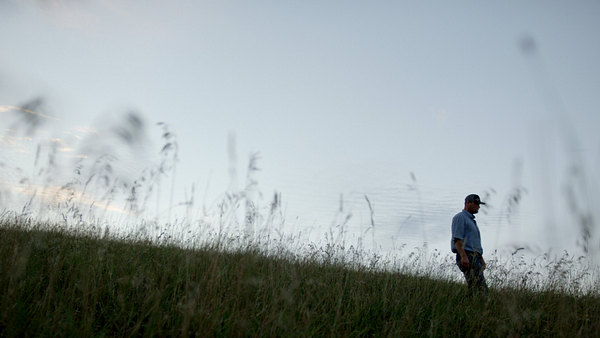
Ernie and George along with their dad operate a mid-sized commercial sheep enterprise.  They will lamb between 3400 & 3500 ewes in April and maintain about 200 commercial cows.  The sheep are predominantly Rambouillet  and lambed in barns on their spring range and will be moved to summer range in early July.  The summer range, about 25,000 acres is primarily forest service permits above 9000 feet and this is where we spent the day.  Summer range runs to elevations above 13,000 feet. This was definitely 4WD Jeep country and was not suited to a bus so we traveled in Suburbans, Tahoes, Pathfinders and anything else we could get our hands on.  The views, the sheep and a picnic at around 12,000 feet  were wonderful, but for a better idea of the road we were on, make sure to look at the snapshots at the bottom of this page.

Mel Coleman, a fourth generation Colorado rancher, founded Coleman Natural Beef  in 1979.  The ranch is located in Saguache and corporate offices are located in Denver.  Cattle with the Coleman Natural Beef label have never received antibiotics or additional hormones.  Their mission is “to produce a good tasting, high quality, safe and wholesome product for consumers interested in a product free of antibiotics, chemical residues, and added hormones”.  Cattle for the Coleman Natural Beef program are supplied by their own ranch in addition to about 700 cooperating farms and ranches.  The cattle are harvested at their plant in Denver and verified by USDA inspectors.  Currently, their own cow herd numbers are down considerably because of an extended drought.

C o l o r a d o

Highlights  from the 2005 WVCA Tour. Photos by Jim Pritchard and Roger Nestor

Coleman Natural Beef - Saguache, CO

Ernie and George Etchart - Montrose/Silverton CO

 Colorado Snapshots

Top two photos - These are a set of photos from the front and back of our vehicle while driving on a “road not suitable for a bus”  I took the front photo and Roger took the back one.  He said he really didn’t need to see where we were going.


Left - Roadside photo along Route 550 south of Oury, CO.


Bottom Left - Fire-fighting helicopter loading water on Redd Ranches


Bottom Right - Cow herd at Redd Ranches


Bottom - View below Red Mountain Pass

Redd Ranches has been in the seedstock business 87 years.  Wayne’s advisor at Colorado State in the mid 70’s considered Paul Redd one of if not the best seedstock producer in Colorado.  Their program has changed some over the years, but not their commitment to the cattle industry.  At  one time Redd Ranches was a predominantly Hereford program but now also includes Red Angus, Angus, Gelbvieh and several composites made up of these breeds.  They will calve about 1500 cows this year.  About half of these are commercial and they will retain ownership of their calves to harvest; a regular practice sine 1965.  Redd Ranches is one of those outfits that thinks outside the box.  We did not have a chance to see the cattle on their winter range, a place Paul said we would enjoy but we did see some of their cattle and part of the 180,000+ acres they run on.  Redd Ranches is also home to a small band of Quarter Horses and these are the working cow horse kind.  Horses are a very important part of their ranching program and according to Paul he doesn’t get enough time in the saddle to see the beautiful West.

Mex & sons is a family operation that consists of about 1000 mother cows and 1200-1300 yearlings.  The ranch operation ranges in altitude from about 7000-9000+ feet and consists of both owned and rented land.  The ranch typically has retained ownership in most, if not all, of their calves for over 20 years and finishes them in Kansas.  As a part of this program, the lighter end of the calves go onto wheat pasture in Kansas until about April and then go to a feedlot.  Raymond says they do a lot of work on horseback and that includes maintaining about 400 miles of fence.

Raymond Snyder (Mex & sons) - Norwood CO

Redd Ranches - Paradox, CO

Mesa Verde, Spanish for "green table", offers an unparalleled opportunity to see and experience a unique cultural and physical landscape. The culture represented at Mesa Verde reflects more than 700 years of history. From approximately A.D. 600 through A.D. 1300 people lived and flourished in communities throughout the area, eventually building elaborate stone villages in the sheltered alcoves of the canyon walls. Today most people call these sheltered villages "cliff dwellings". The cliff dwellings represent the last 75 to 100 years of occupation at Mesa Verde. In the late 1200s within the span of one or two generations, they left their homes and moved away.


Mesa Verde National Park - Cortez, CO